
 Posts
Posts


After 244 years, the Encyclopaedia Britannica is going out of print.
Those coolly authoritative, gold-lettered reference books that were once sold door-to-door by a fleet of traveling salesmen and displayed as proud fixtures in American homes will be discontinued, company executives said.
In an acknowledgment of the realities of the digital age — and of competition from the Web site Wikipedia — Encyclopaedia Britannica will focus primarily on its online encyclopedias and educational curriculum for schools. The last print version is the 32-volume 2010 edition, which weighs 129 pounds and includes new entries on global warming and the Human Genome Project.
Showing posts with label news. Show all posts
Showing posts with label news. Show all posts
Wednesday, March 14, 2012
Encyclopedia Britannica Goes out of Print!


Tuesday, December 6, 2011
JTA - Jewish News Archive
The JTA Jewish News Archive is a powerful reference tool that offers a perspective on current events and modern Jewish history that is not available anywhere else. With free access to nearly a century of reporting about global events affecting world Jewry, the Archive will not only serve as a rich resource for both the casually curious as well as students and scholars of modern Jewish history, it will also transform the way the next generation of Jewish leaders and activists learn about their heritage.
Until now, there has been no authoritative site that provides a comprehensive chronicle of modern Jewish history, as seen through the eyes of journalists. From the aftermath of World War I, to the rise of Nazi Germany, through the Holocaust, the creation of the modern State of Israel and right up to today, JTA journalists have been reporting on stories and issues affecting Jews around the globe. The JTA Jewish News Archive holds over a quarter-million articles They provide a unique lens through which to view world events that no other news organization provides.
“The JTA Jewish News Archive has the potential to spark an interest in the past that will transform the future,” says Jonathan Sarna, the Joseph H. & Belle R. Braun Professor of American Jewish History at Brandeis University and director of its Hornstein Jewish Professional Leadership Program. Professor Sarna, a member of JTA’s Board of Directors, chaired the project.
It has long been JTA’s mission to document the narrative of modern Jewish history. JTA was founded in the waning days of World War I by Jacob Landau as a mechanism for transmitting vital information about what was happening in Jewish communities in various parts of the world. Orginally named the Jewish Correspondence Bureau, it was, in fact, the first news agency that not only gathered but also disseminated news in every part of the world.
The tag line on the logo, "Writing the first draft of Jewish history since 1917" reflects the reality that the correspondents reported what they could confirm at that time. It is possible that some of the facts in these articles were proven erroneous when more deliberate research became possible . As a news service, though, JTA reported events that would have otherwise not been documented. That is the nature of news reporting, particularly during times of war or political repression.
Throughout our long history, JTA has earned its reputation for journalistic integrity, outstanding reporting and insightful analysis. Over the years, the Jewish community has come to rely on JTA as the single most credible source of news and analysis available about events and issues of Jewish interest anywhere in the world.
Headquartered in New York, JTA is a not-for-profit corporation governed by an independent Board of Directors. It has no allegiance to any specific branch of Judaism or political viewpoint. We receive funding from a diverse array of sources.
Wednesday, November 16, 2011
ThomasNet® - Product Sourcing and Supplier Discovery Platform
ThomasNet® - Product Sourcing and Supplier Discovery Platform
“usually don’t add items that I know about and aren’t likely to forget, but the product news and guides areas ore new to me having not visited the site recently ….” HSM
ThomasNet, powered by Thomas Register® and Thomas Regional®, is an industrial search engine that provides one source for finding the exact product, service, or supplier –quickly and efficiently. ThomasNet provides direct access to the detailed information needed to make a purchasing or specifying decision, including line-item product details, CAD drawings, and more.
ThomasNet is brought to you by Thomas Industrial Networksm, a wholly owned subsidiary of Thomas Publishing Company. Thomas has been connecting industrial buyers and suppliers for over 100 years
ThomasNet Product News Room provides current, reliable industrial news articles which are delivered on a timely basis covering the whole range of products from adhesives through waste handling equipment. This premier news source serves the new product information needs of the industrial marketplace through websites, RSS (Really Simple Syndication) feeds, e-marketplaces and online publications.
ThomasNet Need-To-Know Guides
- Maybe you're just looking for some ground-level information. Maybe you need to make an informed sourcing decision. Whatever the reason, whatever you're looking for, these primers, briefs, articles and guides serve as your gateway to learning more. Each resource category offers a wealth of information aimed at providing you with the background and facts you need. Whether you're trying to track down the basics on a certain manufacturing process or deciding between various equipment vendors, ThomasNet's Need-to-Know Guides connects you to key industry info.
Thursday, September 15, 2011
Going Green, Fuel Efficiency, Organic Food, and Green Living - The Daily Green
Going Green, Fuel Efficiency, Organic Food, and Green Living - The Daily Green
TheDailyGreen.com is a consumer's guide to green living, with daily news, tips, recipes, features and more. In 2007, TheDailyGreen.com was named Best New Site in the annual min Best of the Web awards. In 2010, TheDailyGreen.com was voted "Best Blog" by readers in the annual Best of Green Awards. In 2011, TheDailyGreen.com joined forces with Good Housekeeping and the Green Good Housekeeping Seal on an exciting new content partnership.
The annual Heart of Green Awards honor individuals, businesses and organizations that, like TheDailyGreen.com, are helping to make green go mainstream. In 2009 and 2010, TheDailyGreen.com celebrated its awards with star-studded ceremonies at at the Hearst Tower in Manhattan (see video at right). In 2011, the awards' scope expanded with many more categories, more winners and more audience participation - with the advent of online voting.
Read more: http://www.thedailygreen.com/about/about-us#ixzz1XIE10F00
Guide to Greener Electronics | Greenpeace International
Guide to Greener Electronics | Greenpeace International
Guide to Greener Electronics
The guide ranks the 18 top manufacturers of personal computers, mobile phones, TVs and games consoles according to their policies on toxic chemicals, recycling and climate change. Last updated: October 2010. A new updated version is due out in November 2011.
Our three goals for this guide are to get companies to:
- Clean up their products by eliminating hazardous substances.
- Take back and recycle their products responsibly once they become obsolete.
- Reduce the climate impacts of their operations and products.
Wednesday, September 14, 2011
Home – Electronics TakeBack Coalition
Home – Electronics TakeBack Coalition
The Electronics TakeBack Coalition (ETBC) promotes green design and responsible recycling in the electronics industry. Our goal is to protect the health and well being of electronics users, workers, and the communities where electronics are produced and discarded by requiring consumer electronics manufacturers and brand owners to take full responsibility for the life cycle of their products, through effective public policy requirements or enforceable agreements.
We will accomplish this goal in part by establishing extended producer responsibility (EPR) as the policy tool to promote sustainable production and consumption of consumer electronics (all products with a circuit board). EPR will improve the next generation of solid waste and toxic materials policy, promote the manufacture of cleaner computers and curb the flow of toxic electronic waste by pushing manufacturers to take responsibility for their waste, internalizing its cost in corporate bottom lines, and phasing out the use of hazardous substances.
Wednesday, September 7, 2011
Rudd Center for Food Policy & Obesity — Home
Rudd Center for Food Policy & Obesity — Home
The Rudd Center for Food Policy & Obesity is a non-profit research and public policy organization devoted to improving the world’s diet, preventing obesity, and reducing weight stigma. The Rudd Center serves as a leader in building broad-based consensus to change diet and activity patterns, while holding industry and government agencies responsible for safeguarding public health. The Center serves as a leading research institution and clearinghouse for resources that add to our understanding of the complex forces affecting how we eat, how we stigmatize overweight and obese people, and how we can change.
What We Do
Our charge is to reverse the global spread of obesity; to reduce weight bias; and to galvanize community members, public officials, and advocacy groups to achieve positive, lasting change.
How We Do It
The Rudd Center pursues our bold goals through: strategic science; interaction with key players in media, industry, and government; and mobilization of grassroots efforts. The Center stands at the intersection of science and public policy to develop innovative and effective measures to combat obesity and improve global health.
Includes publications, podcasts, policy statements, image gallery and seminar series.
Early Journal Content on JSTOR, Free to Anyone in World | JSTOR
Early Journal Content on JSTOR, Free to Anyone in World
On September 6, 2011, we announced that we are making journal content in JSTOR published prior to 1923 in the United States and prior to 1870 elsewhere freely available to anyone, anywhere in the world. This “Early Journal Content” includes discourse and scholarship in the arts and humanities, economics and politics, and in mathematics and other sciences. It includes nearly 500,000 articles from more than 200 journals. This represents 6% of the content on JSTOR.
While JSTOR currently provides access to scholarly content to people through a growing network of more than 7,000 institutions in 153 countries, we also know there are independent scholars and other people that we are still not reaching in this way. Making the Early Journal Content freely available is a first step in a larger effort to provide more access options to the content on JSTOR for these individuals.
The Early Journal Content will be released on a rolling basis beginning today. A quick tutorial about how to access this content is also available.
We encourage broad use of the Early Journal Content, including the ability to reuse it for non-commercial purposes. We ask that you acknowledge JSTOR as the source of the content and provide a link back to our site. Please also be considerate of other users and do not use robots or other devices to systematically download these works as this may be disruptive to our systems. For more information, you can read a new section about Early Journal Content in our Terms & Conditions of Use.
If you would like to be notified of the first and subsequent releases of the Early Journal Content, you may follow us on Twitter or Facebook.
Please read our Frequently Asked Questions if you have additional questions about the Early Journal Content or contact us at support@jstor.org.
Download a brief program description that lists some Early Journal Content highlights.
Early Journal Content on JSTOR, Free to Anyone in World | JSTOR
Friday, September 2, 2011
Home | ReliefWeb
ReliefWeb is your source for timely, reliable and relevant humanitarian information and analysis.
Our goal is to help you make sense of humanitarian crises worldwide. To do this, we scan the websites of international and non-governmental organizations, governments, research institutions and the media for news, reports, press releases, appeals, policy documents, analysis and maps related to humanitarian emergencies worldwide. We then ensure the most relevant content is available on ReliefWeb, or delivered through your preferred channel (RSS, e-mail, Twitter or Facebook).
We also produce maps and infographics to illustrate and explain humanitarian crises. To ensure ReliefWeb is updated around the clock, we maintain offices in three different time zones: Kobe (Japan), Geneva (Switzerland) and New York (USA). Wherever you are in the world, you can follow ReliefWeb on Twitter and Facebook, where we tweet on important and interesting humanitarian events, issues and content that we come across.
Tuesday, August 30, 2011
Social Media News and Web Tips – Mashable – The Social Media Guide
Social Media News and Web Tips – Mashable – The Social Media Guide
Mashable is the largest independent news source dedicated to covering digital culture, social media and technology. Mashable reports on the importance of digital innovation and how it empowers and inspires people around the world.
Mashable’s 13 million monthly unique visitors and 4 million social media followers have become one of the most engaged online news communities. Numerous studies and leading publications have declared Mashable the most influential online news outlet and a must-read site.
Mashable also syndicates its content to top publications including ABC News, CNN, Forbes, Metro, USA Today and Yahoo! News, amplifying its reach to many millions of additional readers each month.
Pete Cashmore founded Mashable in 2005 in Aberdeenshire, Scotland. His passion for sharing how web tools and social networks were transforming human interactions and reshaping cultures drove him to create what would become Mashable.
Mashable is headquartered in New York City, with an office in San Francisco. Mashable’s growing team can also be found across the United States, United Kingdom and in Eastern Europe
eXtension - Objective. Research-based. Credible.
eXtension - Objective. Research-based. Credible.
eXtension is an interactive learning environment delivering the best, most researched knowledge from the smartest land-grant university minds across America. eXtension connects knowledge consumers with knowledge providers - experts who know their subject matter inside out.
eXtension offers:
- Credible expertise
- Reliable answers based upon sound research
- Connections to the best minds in American universities
- Creative solutions to today's complex challenges
- Customized answers to your specific needs
- Trustworthy, field-tested data
- Dynamic, relevant and timely answers
eXtension is unlike any other search engine or information-based website. It's a space where university content providers can gather and produce new educational and information resources on wide-ranging topics. Because it's available to students, researchers, clinicians, professors, as well as the general public, at any time from any Internet connection, eXtension helps solve real-life problems in real time.
eXtension Foundation: The eXtension Foundation is a non-profit entity that exists to support the work of eXtension. Learn more about how you can support or sponsor this work at our eXtension Foundation.
Thursday, June 9, 2011
Disappeared: Google’s U.S. Government Search Sites and Other Special Search Interfaces Gone « INFOdocket
Disappeared: Google’s U.S. Government Search Sites and Other Special Search Interfaces Gone
Posted on June 6, 2011 by Gary D. Price
In the past few days we began noticing a number of Google Help Forum posts from users reporting that Google’s-Uncle Sam search is unavailable. The Uncle Sam interface provided a search of only government and military material and has been online for MANY years. “Uncle Sam” continues to redirect users to the Google homepage at this hour.
Another Google U.S. government search resource, USGov.Google.com is ALSO redirecting to the Google homepage. This site was “rebranded” on June 15, 2006 and received notice from a variety of sources. The USGov.Google.com documentation does remain online.
Reports say that users first noticed the redirects on June 2, 2011.
On Search Engine Roundtable, Barry Schwartz has also posted on the disappearance of both sites. He points out that Google is using a temporary redirect so perhaps this is a glitch or something else.
We wonder (and this is only a guess) if some new government site is planned to go live next week as USgov.Google.com marks its fifth anniversary.
As we’ve said in the past with similar situations, our issue is not with Google ending a service or temporarily taking it offline.
What does cause concern is that Google doesn’t let users know what’s going on until sometime after it happens or never make an announcement Just because a service like USGov.Google.com is not used by the masses use doesn’t mean it’s any less important to those who do use it.
The reason for this might have something to do with advanced search sites and features in general. While 95% of users never use advanced search syntax (including members of the search team at Google) there are 5% of users who DO utilize these tools when they’re needed. With the vast amount of resources that Google has it’s difficult to imagine that they don’t have what’s needed to keep updates coming about comings and goings, syntax problems, etc.
In many cases Google is at or near the top of the list for getting their message(s) out to the public but in some situations it appears the opposite is true. We hope that the company looks at why this happens and find a way or ways to combat it.
INFOdocket finds it rather ironic that a company whose mission includes providing access to all of the world’s information has trouble providing updated info to users.
UPDATE: It appears that all of Google’s “Special Searches” for conducting limited searches of material about Linux, Macintosh, BSD, Microsoft as well as Uncle Sam are gone. Again, if this is the case why is the info page still live with the URL’s listed? Confusing! Why couldn’t a sentence or two explaining what’s going on be added to the page?
Wednesday, May 25, 2011
Scientists on Twitter - Astronomers, Biologists, and Chemists, and more - Science Pond
Scientists on Twitter - Astronomers, Biologists, and Chemists, and more - Science Pond
About Science Pond
Welcome to the pond! For this Twitter experiment we'll need science nerds of all stripes, including scientists, bloggers, journalists, educators, and students. The criteria for inclusion: on-topic feeds in English that are interesting and useful--to your peers at the very least. If you're still not sure, this seems like the perfect time to quote Albert Einstein: "Most people say that is it is the intellect which makes a great scientist. They are wrong: it is character."
Science Blogging Aggregated
Scienceblogging.org (also Scienceblogging.com) is a new central clearinghouse for all your science needs. Built by Anton Zuiker, Bora Zivkovic and Dave Munger, the page will aggregate RSS feeds from all the major (and some minor) science blogging networks, group blogs, aggregators and services. As the site develops further, it will also encompass other online (and offline) science communication efforts, including Twitter feeds, links to major scientific journals and magazines, ScienceOnline annual conference, and the Open Laboratory annual anthology of the best writing on science, nature and medical blogs.
We are asking the community to help. Let us know when we make an error, when a new network arises or a new RSS feed goes live.
Scientopia
Scientopia is a collective of people who write about science because they love to do so. It is a community, held together by mutual respect and operated by consensus, in which people can write, educate, discuss, and learn about science and the process of doing science. In this we explore the interplay between scientific issues and other parts of our lives with the shared goal of making science more accessible.
As a community, we strive to be welcoming of anyone with an interest in science and its place in our world, regardless of any feature, whether extrinsic or intrinsic, which may act or have historically acted as a barrier to full participation in science or discourses about science.
ScienceBlogs
About ScienceBlogs
Science is driving our conversation unlike ever before.
From climate change to intelligent design, HIV/AIDS to stem cells, science education to space exploration, science is figuring prominently in our discussions of politics, religion, philosophy, business and the arts. New insights and discoveries in neuroscience, theoretical physics and genetics are revolutionizing our understanding of who are are, where we come from and where we're heading. Launched in January 2006, ScienceBlogs is a portal to this global dialogue, a digital science salon featuring the leading bloggers from a wide array of scientific disciplines. Today, ScienceBlogs is the largest online community dedicated to science.
We believe in providing our bloggers with the freedom to exercise their own editorial and creative instincts. We do not edit their work and we do not tell them what to write about.
We have selected our 80+ bloggers based on their originality, insight, talent, and dedication and how we think they would contribute to the discussion at ScienceBlogs. Our role, as we see it, is to create and continue to improve this forum for discussion, and to ensure that the rich dialogue that takes place at ScienceBlogs resonates outside the blogosphere.
ScienceBlogs is very much an experiment in science communication, and being first also means being first to encounter unforeseen obstacles. We are learning as we go (and as goes the blogosphere) and appreciate your understanding and patience.
ScienceBlogs was created by Seed Media Group. We believe that science literacy is a pre-condition for progress in the 21st century. At a time when public interest in science is high but public understanding of science remains weak, we have set out to create innovative media ventures to improve science literacy and to advance global science culture. To learn more about what we do and why we do it, please visit seedmediagroup.com.
PLoS Blogs Network
About PLoS Blogs
PLoS has always engaged in debate about science and medicine. Starting with the launch of our main blog, plos.org, back in 2006, PLoS quickly realized how informal communication can catch readers’ attention. PLoS ONE then launched their journal blog, everyONE in March 2009. Two months later, the editors of PLoS Medicine started Speaking of Medicine to interact with those interested in global health.
PLoS Blogs has been set up to bring a select group of independent science and medicine bloggers together with the editors and staff who run our blogs. Our independent network is made up of writers who love science and medicine, and scientists and physicians that love to write. Here, you’ll find an equal mix of blogs from journalists and researchers tackling diverse issues in science and medicine.
Here are the details of our network:
- Our Blog network is 100% ad-free
- All material is posted to the blog under the Creative Commons Open Access License (CCAL 3.0 Commercial)

“With a Creative Commons license, you keep your copyright but allow people to copy and distribute your work provided they give you credit.”
- There are three very distinct types of blogs on the PLoS Blogs network: the official PLoS blog, the PLoS journal blogs (collectively known as The PLoS Blogs), and blogs from the independent network (a.k.a. The PLoS Blogosphere)
- The official PLoS blog: This content is produced, edited, and/or maintained by PLoS staff.
- The journal blogs: This content is produced, edited, and/or maintained by PLoS journal staff: The current journal blogs are Speaking of Medicine (PLoS Medicine’s blog) and everyONE (PLoS ONE’s blog).
- Our independent network of bloggers (The PLoS Blogosphere): This content is produced, edited, and/or maintained by the authors.
- All of the content in The PLoS Blogosphere came from the minds of the authors. PLoS does not screen, edit, or otherwise meddle with content on the these blogs in any way. Our bloggers and our users are held to exactly the same standards, and the community guidelines apply to everyone that uses our site. If a blogger has posted content that you believe violates our site abuse policy, please contact PLoS here.
- Bloggers monitor their own comment threads: All comments will be reviewed by the author of the blog where you leave your thoughts. Just follow our simple community guidelines and we’ll all get along just fine.
Friday, March 11, 2011
Bloomberg - Business & Financial News, Breaking News Headlines
Bloomberg - Business & Financial News, Breaking News Headlines
In 1981 Bloomberg started out with one core belief: that bringing transparency to capital markets through access to information could increase capital flows, produce economic growth and jobs, and significantly reduce the cost of doing business. Today’s Bloomberg builds on that foundation - everything we do connects decision makers in business, finance and government to a broad and dynamic network of information, news, people and ideas that enables faster, more effective decisions. Come see how we do it.
Tuesday, January 25, 2011
The Iowa State Daily's Sidebar Mistake Accidentally Condones Rape
The Iowa State Daily's Sidebar Mistake Accidentally Condones Rape
First Posted: 01/14/11 09:49 AM Updated: 01/19/11 03:21 PM
Read More: Iowa State Daily, Iowa State Daily Consent, Iowa State Daily Mistake, Photo, College News
As newspaper mistakes go, this one's a whopper.
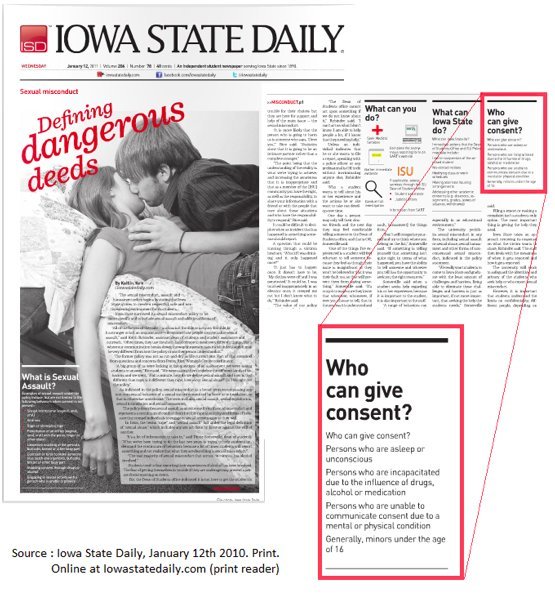
A recent sidebar on a sexual assault article in the Iowa State Daily mistakenly said it was okay to have sex with those who are asleep, unconscious, inebriated, incapacitated, debilitated or under 16.
The sidebar's header in the Daily's Jan. 12 print edition read "Who can give consent?" An editor's note appended to the online version of the article states that the header was supposed to read "Who cannot give consent?"
The Daily's error has picked up speed around the web and has been sarcastically deemed a "great moment in student journalism."
Alas, student newspaper expert Dan Reimold offers some perspective on his blog College Media Matters, saying that the error shouldn't "distract from what appears to be a well-written story and nice design."
And a reminder to the folks at the Daily -- tomorrow is a new day.
UPDATE: Daily Editor-in-Chief Jessie Opoien has appended an additional note to the article. It says in part:
Posted: Sunday, January 16, 2011 5:17 pm | Updated: 5:46 pm, Sun Jan 16, 2011.
The Daily's sidebar mistake By Jessica Opoien, jessica.opoien@iowastatedaily.com Iowa State Daily
On Jan. 12, 2011, the Iowa State Daily published an article about the sexual assault, misconduct and harassment policy at Iowa State, written by Kaitlin York. The story, headlined in print as "Defining dangerous deeds," and online as "Understanding the policies for sexual assault," was about a very serious issue on college campuses.
The story was accompanied by three sidebars, with the intention of providing more information about sexual misconduct. However, a very unfortunate error, on our part, has made one of those sidebars infamous across the Internet. The sidebar, "Who cannot give consent?" was headlined, in print, as "Who can give consent?"
The error, of course, dramatically changed the information that was presented in the sidebar. Copy errors run in publications every day, but this was more severe than the average newspaper misprint.
This was nothing more than a mistake on our part -- not, as some online commenters have suggested, the product of someone with a sick sense of humor. Sexual misconduct is not a laughing matter, and, too often, careless jokes are made that can numb us and make us forget the seriousness of the matter. The Iowa State Daily does not condone sexual misconduct, and we do not take this issue lightly. We deeply regret any offense we may have caused.LOOK:

The Iowa State Daily's Sidebar Mistake Accidentally Condones Rape
Wednesday, June 9, 2010
Futurity.org
Futurity aggregates the very best research news. The content is produced by the partner universities, and submitted to Futurity’s editor, Jenny Leonard (editor@futurity.org) , for consideration. The site, which is hosted at the University of Rochester, covers research findings in a range of topics, inluding the environment, health, science, and society.
Subscribe to:
Comments (Atom)