Showing posts with label health. Show all posts

Thursday, December 1, 2011

CPSC Home Page | cpsc.gov


CPSC Home Page | cpsc.gov


About SaferProducts.gov

SaferProducts.gov is the Publicly Available Consumer Product Safety Information Database website of the U.S. Consumer Product Safety Commission (CPSC).

The U.S. Consumer Product Safety Commission is charged with protecting the public from unreasonable risks of injury or death from thousands of types of consumer products under the agency’s jurisdiction. The CPSC is committed to protecting consumers and families from products that pose a fire, electrical, chemical, or mechanical hazard or can injure children. The CPSC’s work to ensure the safety of consumer products—such as toys, cribs, power tools, cigarette lighters, and household chemicals—contributed significantly to the decline in the rate of deaths and injuries associated with consumer products over the past 30 years.

Through SaferProducts.gov, consumers, child service providers, health care professionals, government officials and public safety entities can submit reports of harm (Reports) involving consumer products. Manufacturers (including importers) and private labelers identified in Reports will receive a copy of the Report, and have the opportunity to comment on them. Completed Reports and manufacturer comments are published online at www.SaferProducts.gov for anyone to search.
CPSC was required to create a public portal and a publicly accessible, searchable database of consumer product incident reports by the Consumer Product Safety Improvement Act (CPSIA), which became law on August 14, 2008.

Monday, November 21, 2011

Rudd Center for Food Policy & Obesity — Home


Rudd Center for Food Policy & Obesity — Home


The Rudd Center seeks to improve the world’s diet, prevent obesity, and reduce weight stigma by establishing creative connections between science and public policy, developing targeted research, encouraging frank dialogue among key constituents, and expressing a dedicated commitment to real change.

The Rudd Center assesses, critiques, and strives to improve practices and policies related to nutrition and obesity so as to inform and empower the public, to promote objective, science-based approaches to policy, and to maximize the impact on public health.

These objectives are accomplished by addressing the following:

Wednesday, September 7, 2011

Rudd Center for Food Policy & Obesity — Home


Rudd Center for Food Policy & Obesity — Home

The Rudd Center for Food Policy & Obesity is a non-profit research and public policy organization devoted to improving the world’s diet, preventing obesity, and reducing weight stigma. The Rudd Center serves as a leader in building broad-based consensus to change diet and activity patterns, while holding industry and government agencies responsible for safeguarding public health. The Center serves as a leading research institution and clearinghouse for resources that add to our understanding of the complex forces affecting how we eat, how we stigmatize overweight and obese people, and how we can change.

What We Do

Our charge is to reverse the global spread of obesity; to reduce weight bias; and to galvanize community members, public officials, and advocacy groups to achieve positive, lasting change.

How We Do It

The Rudd Center pursues our bold goals through: strategic science; interaction with key players in media, industry, and government; and mobilization of grassroots efforts. The Center stands at the intersection of science and public policy to develop innovative and effective measures to combat obesity and improve global health.


Includes publications, podcasts, policy statements, image gallery and seminar series.

Tuesday, August 30, 2011

eXtension - Objective. Research-based. Credible.


eXtension - Objective. Research-based. Credible.


eXtension is an interactive learning environment delivering the best, most researched knowledge from the smartest land-grant university minds across America. eXtension connects knowledge consumers with knowledge providers - experts who know their subject matter inside out.

eXtension offers:

  • Credible expertise
  • Reliable answers based upon sound research
  • Connections to the best minds in American universities
  • Creative solutions to today's complex challenges
  • Customized answers to your specific needs
  • Trustworthy, field-tested data
  • Dynamic, relevant and timely answers

eXtension is unlike any other search engine or information-based website. It's a space where university content providers can gather and produce new educational and information resources on wide-ranging topics. Because it's available to students, researchers, clinicians, professors, as well as the general public, at any time from any Internet connection, eXtension helps solve real-life problems in real time.

eXtension Foundation: The eXtension Foundation is a non-profit entity that exists to support the work of eXtension. Learn more about how you can support or sponsor this work at our eXtension Foundation.

Monday, August 29, 2011

MetroTrends | Urban Institute's report card on social and economic trends in urban America


Welcome to MetroTrends
The Urban Institute's report card and toolkit for researchers, students, journalists, elected officials and the public on the state of metropolitan economies. Here you'll find up-to-date charts and figures, expert commentaries and relevant, downloadable datasets. learn more

The MetroTrends Blog has launched and brings you seasoned voices on the changes and challenges facing metropolitan America.

MetroTrends | Urban Institute's report card on social and economic trends in urban America

Measure of America: American Human Development Project


Measure of America: American Human Development Project

The American Human Development Project provides easy-to-use yet methodologically sound tools for understanding the distribution of well-being and opportunity in America and stimulating fact-based dialogue about issues we all care about: health, education, and living standards.

The hallmark of this work is the American Human Development Index, an alternative to GDP and other money metrics that tells the story of how ordinary Americans are faring and empowers communities with a tool to track progress over time. The Index is comprised of health, education, and income indicators and allows for well-being rankings of the 50 states, 435 congressional districts, county groups within states, women and men, and racial and ethnic groups.

Through national and state reports, thematic briefs, and the project’s interactive website, the American Human Development Project aims to breathe life into numbers, using data to create compelling narratives that foster greater understanding of our shared challenges and greater support for people-centered policies. The Project was founded in 2006, and became an initiative of the Social Science Research Council (SSRC) in 2008.

The Project is made possible through the Conrad N. Hilton Foundation‘s matching grant, which will match every dollar you donate–effectively doubling your contribution. Click on this secure link to donate today (please note this will direct you to the SSRC website).


The maps are the great interactive part….

http://www.measureofamerica.org/maps/

The Measure of America

How is opportunity distributed in America? Are we falling behind other affluent democracies? Which groups are surging ahead and which face the greatest risks? Which congressional districts enjoy the highest—and lowest—levels of well-being?

Friday, August 26, 2011

CDC - Injury - WISQARS (Web-based Injury Statistics Query and Reporting System)


Welcome to WISQARSTM

WISQARS logoWISQARSTM (Web-based Injury Statistics Query and Reporting System) is an interactive database system that provides customized reports of injury-related data. Learn more about WISQARSTM >>

CDC - Injury - WISQARS (Web-based Injury Statistics Query and Reporting System)

CDC’s WISQARS™ (Web-based Injury Statistics Query and Reporting System) is an interactive, online database that provides fatal and nonfatal injury, violent death, and cost of injury data from a variety of trusted sources. Researchers, the media, public health professionals, and the public can use WISQARS™ data to learn more about the public health and economic burden associated with unintentional and violence-related injury in the United States.

Users can search, sort, and view the injury data and create reports, charts, and maps based on the following:

  • Intent of injury (unintentional injury, violence-related, homicide/assault, legal intervention, suicide/intentional self-harm)
  • Mechanism (cause) of injury (e.g., fall, fire, firearm, motor vehicle crash, poisoning, suffocation)
  • Body region (e.g., traumatic brain injury, spinal cord, torso, upper and lower extremities)
  • Nature (type) of injury (e.g., fracture, dislocation, internal injury, open wound, amputation, and burn)
  • Geographic location (national, regional, state) where the injury occurred
  • Sex, race/ethnicity, and age of the injured person

Friday, April 22, 2011

PopTech : Home


PopTech : Home

What is PopTech?
PopTech is a unique innovation network – a global community of cutting-edge leaders, thinkers, and doers from many different disciplines, who come together to explore the social impact of new technologies, the forces of change shaping our future, and new approaches to solving the world’s most significant challenges. We are known for our thriving community of thought-leaders, breakthrough innovation programs, visionary annual conferences and deep media and storytelling capabilities.

Why We Exist

PopTech’s mission is to accelerate the positive impact of world changing people, projects and ideas. We do this by creating transformational experiences that showcase the ideas, trends, challenges and opportunities that are shaping the future. PopTech fosters breakthrough, multidisciplinary collaborations that help individuals, companies and organizations work together to change the world. Participating in PopTech offers a firsthand glimpse of the future, and a chance to influence innovation.


Videos in the following areas: 

Business
Design
Energy
Entertainment
Environment
Health
Music
Science
Society
Technology


http://poptech.org/popcasts

American Hospital Directory - information about hospitals from public and private data sources including MedPAR, OPPS, hospital cost reports, and other CMS files.

http://ahd.com/

The American Hospital Directory® provides data and statistics about more than 6,000 hospitals nationwide.

AHD.com® hospital information includes both public and private sources such as Medicare claims data, hospital cost reports, and commercial licensors.

AHD® is not affiliated with the American Hospital Association (AHA) and is not a source for AHA Data.  Our data are evidence-based and derived from the most authoritative sources.

Free hospital profiles

Use versatile search tools to explore our database of hospital information.  Create a list or a map of hospitals that match your interests.  View free hospital profiles that include key characteristics, services provided, utilization statistics, accreditation status, financial information, and more.  No registration is required.  Go

Free state & national stats

View key statistics summarized by hospital, state, and the nation.  Statistics include bed size, discharges, patient days, and gross patient revenue.  Go

American Hospital Directory - information about hospitals from public and private data sources including MedPAR, OPPS, hospital cost reports, and other CMS files.

Tuesday, January 25, 2011

The Iowa State Daily's Sidebar Mistake Accidentally Condones Rape


The Iowa State Daily's Sidebar Mistake Accidentally Condones Rape

First Posted: 01/14/11 09:49 AM Updated: 01/19/11 03:21 PM


Read More: Iowa State Daily, Iowa State Daily Consent, Iowa State Daily Mistake, Photo, College News

Iowa State Daily Consent


As newspaper mistakes go, this one's a whopper.

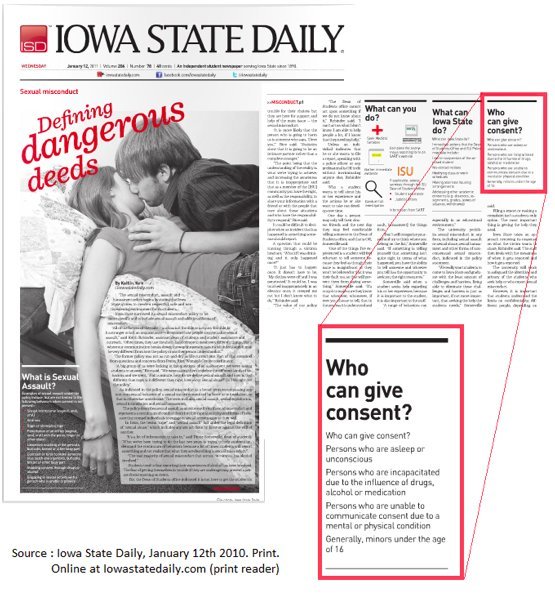
A recent sidebar on a sexual assault article in the Iowa State Daily mistakenly said it was okay to have sex with those who are asleep, unconscious, inebriated, incapacitated, debilitated or under 16.

The sidebar's header in the Daily's Jan. 12 print edition read "Who can give consent?" An editor's note appended to the online version of the article states that the header was supposed to read "Who cannot give consent?"

The Daily's error has picked up speed around the web and has been sarcastically deemed a "great moment in student journalism."

Alas, student newspaper expert Dan Reimold offers some perspective on his blog College Media Matters, saying that the error shouldn't "distract from what appears to be a well-written story and nice design."

And a reminder to the folks at the Daily -- tomorrow is a new day.

UPDATE: Daily Editor-in-Chief Jessie Opoien has appended an additional note to the article. It says in part:

Posted: Sunday, January 16, 2011 5:17 pm | Updated: 5:46 pm, Sun Jan 16, 2011.

The Daily's sidebar mistake By Jessica Opoien, jessica.opoien@iowastatedaily.com Iowa State Daily

On Jan. 12, 2011, the Iowa State Daily published an article about the sexual assault, misconduct and harassment policy at Iowa State, written by Kaitlin York. The story, headlined in print as "Defining dangerous deeds," and online as "Understanding the policies for sexual assault," was about a very serious issue on college campuses.

The story was accompanied by three sidebars, with the intention of providing more information about sexual misconduct. However, a very unfortunate error, on our part, has made one of those sidebars infamous across the Internet. The sidebar, "Who cannot give consent?" was headlined, in print, as "Who can give consent?"

The error, of course, dramatically changed the information that was presented in the sidebar. Copy errors run in publications every day, but this was more severe than the average newspaper misprint.


This was nothing more than a mistake on our part -- not, as some online commenters have suggested, the product of someone with a sick sense of humor. Sexual misconduct is not a laughing matter, and, too often, careless jokes are made that can numb us and make us forget the seriousness of the matter. The Iowa State Daily does not condone sexual misconduct, and we do not take this issue lightly. We deeply regret any offense we may have caused.

View the note in full here.

LOOK:

The Iowa State Daily's Sidebar Mistake Accidentally Condones Rape

Thursday, May 14, 2009

UpToDate Inc.

UpToDate Inc. 

UpToDate is an evidence based, peer reviewed information resource - available via the Web, desktop computer, and PDA.

With UpToDate, you can answer questions quickly, increase your clinical knowledge, and improve patient care. Independent studies confirm these benefits.

The UpToDate community includes our faculty of more than 4,000 leading physicians, peer reviewers, and editors and over 360,000 users. Our faculty writes topic reviews that include a synthesis of the literature, the latest evidence, and specific recommendations for patient care. Our users provide feedback to the editorial group. This community's combined efforts result in the most trusted, unbiased medical information available.


UpToDate Inc.